From a Cancelled Tournament to a Cameroon Double-Header — The Preparation Data
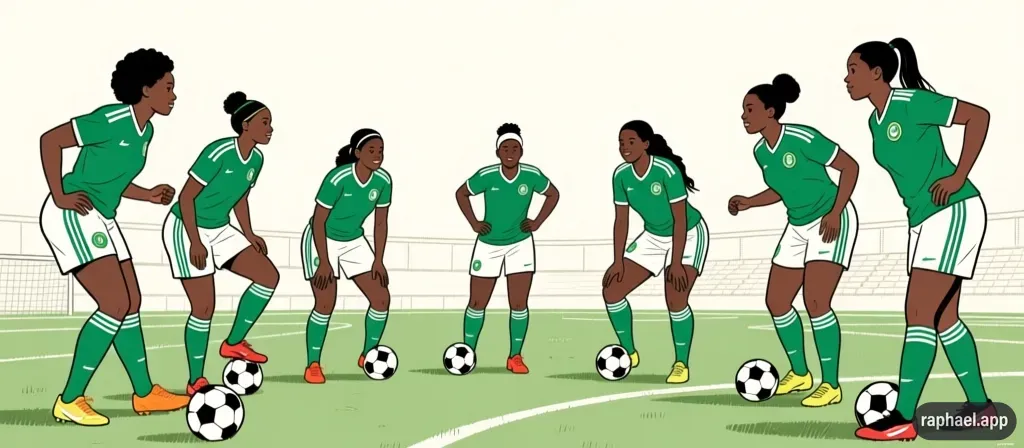
Nigeria's Super Falcons, the reigning Women's Africa Cup of Nations (WAFCON) champions and record 11-time winners of the continental title, were originally scheduled to feature in the WAFU B invitational tournament alongside Ghana, Côte d'Ivoire, and Senegal — a 4-team event designed to provide competitive minutes ahead of WAFCON 2026. That plan collapsed when Ghana withdrew, forcing the tournament's cancellation and leaving the Falcons without a structured warm-up window. Head coach Justine Madugu pivoted quickly, arranging a double-header friendly series against Cameroon's Indomitable Lionesses — arguably the most valuable replacement fixture available. The first match takes place on Saturday, February 28, at the Military Stadium in Yaoundé, with the second scheduled for Tuesday, March 3, at the same venue. Two matches in 4 days against a continental rival provides a compressed but intense preparation block, offering data on player fitness, tactical adaptability, and squad depth that a single friendly simply cannot deliver.
The squad assembled in Yaoundé reflects Madugu's dual approach of integrating new talent while recalling proven performers. A total of 15 players reported to camp, with 11 arriving in the initial wave. Among the recalled veterans are midfielder Ngozi Okobi-Okeoghene, who returns after a maternity break, and defender Chidinma Okeke — both players with extensive WAFCON experience across multiple tournament cycles. Madugu has also handed call-ups to several uncapped or lightly capped players, signalling his intent to expand the selection pool before the continental showpiece. In his own words, the objective is clear: improve team cohesion and evaluate whether new faces can provide genuine tactical alternatives ahead of the title defence. With WAFCON 2026 on the horizon, these 2 matches represent the last significant opportunity to test combinations in a competitive setting against high-calibre opposition before the squad is finalised.
Nigeria vs Cameroon — A Rivalry Measured in Decades and Trophies
The choice of Cameroon as the friendly opponent is far from arbitrary. Nigeria and Cameroon have been the two dominant forces in African women's football for over two decades, and their head-to-head record reads like a history of the WAFCON itself. The Super Falcons' 11 continental titles dwarf every other nation on the continent, but Cameroon have consistently been the team most capable of challenging that dominance, reaching multiple WAFCON finals and qualifying for the FIFA Women's World Cup on 2 occasions. Matches between the two sides are typically tight, physical, and tactically demanding — exactly the kind of test that exposes weaknesses a coaching staff needs to identify months before a tournament. For Madugu, the Yaoundé double-header offers real-time data on how his squad handles the pressing intensity, aerial duels, and transition speed that Cameroon consistently bring. Any new player who performs well across both legs against the Lionesses will have demonstrated their readiness for WAFCON-level football in a way that training sessions alone cannot replicate.
The broader context adds urgency. Nigeria's title defence at WAFCON 2026 comes with the expectation of a 12th continental crown, a target that would further extend their record as the most successful nation in the tournament's history. But the competitive landscape in African women's football has tightened considerably — South Africa won the 2022 edition before Nigeria reclaimed the trophy, and teams like Zambia and Morocco have invested heavily in their women's programmes. Madugu's preparation window is narrow: after the Cameroon friendlies, meaningful competitive fixtures before the tournament will be scarce. The data gathered across these 2 matches — minutes logged by new call-ups, defensive organisation under pressure, set-piece efficiency, and the integration of returning veterans like Okobi-Okeoghene — will directly inform squad selection and tactical planning for the months ahead. In a tournament where margins between winning and losing are often decided by a single goal, the information extracted from Yaoundé could prove as valuable as any result on the scoreboard.