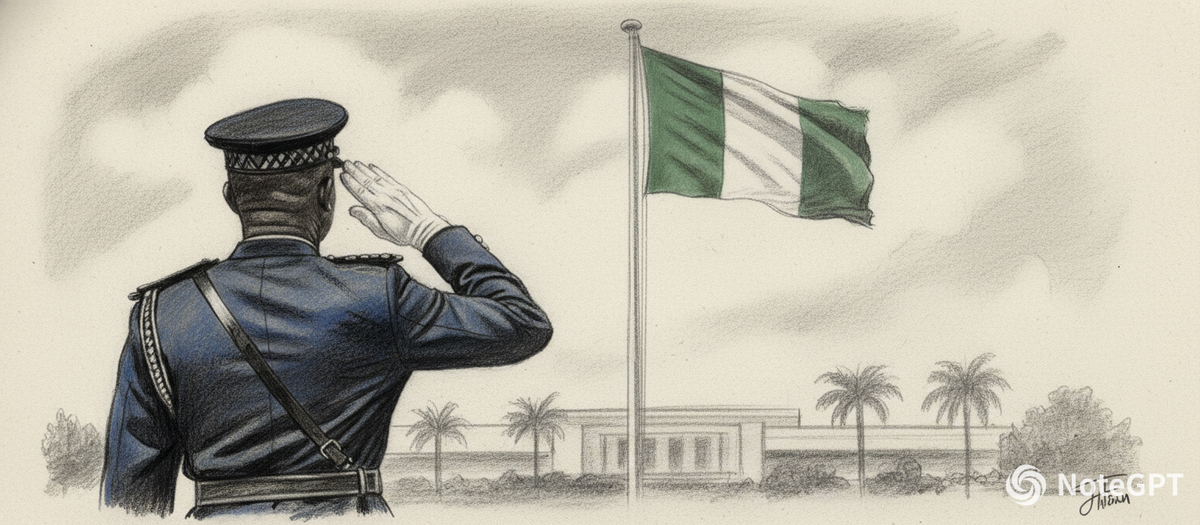
President Tinubu taps a veteran Lagos officer to lead 371,800 police personnel confronting a security emergency that claimed nearly 12,000 lives last.
ABUJA, Nigeria — Standing in the ceremonial hall of the presidential villa on Tuesday, President Bola Tinubu pinned new insignia on the uniform of Olatunji Rilwan Disu and delivered a charge that was equal parts confidence and candor. "Nigeria is challenged with banditry, terrorism and other criminal activities," Tinubu told the newly decorated Acting Inspector-General of Police. "Lead firmly but fairly." The appointment places Disu, a 59-year-old career officer with 34 years in the force, at the helm of one of Africa's largest — and most beleaguered — law enforcement agencies. He succeeds Kayode Egbetokun, who retired after completing his tenure, and assumes command at a moment when the scale of Nigeria's security crisis has begun to rival that of active war zones. According to data from the Armed Conflict Location and Event Data Project, Nigeria recorded nearly 12,000 conflict-related deaths in 2025 — a toll that exceeded fatalities reported in several major theaters of violence in the Middle East. A separate analysis by Nextier Advisory Ltd. documented 4,654 lives lost and 3,141 people kidnapped across 1,274 distinct violent incidents during the same period. In the first six months of 2025 alone, the security firm Beacon Security and Intelligence Limited counted 6,800 deaths and 5,400 kidnappings nationwide. The northwest has been the epicenter. A report by SBM Intelligence found that 2,938 people were abducted in the region between July 2024 and June 2025, accounting for more than 60 percent of reported kidnapping incidents across the country. In January of this year, gunmen seized approximately 177 people from three churches in Kaduna State in a single day. It is into this landscape that Disu steps — armed with a presidential mandate, a reputation for operational toughness, and a police force that analysts say is critically under-resourced for the task.
A Force Stretched to Its Limits
The Nigeria Police Force fields roughly 371,800 officers to serve a population of approximately 236.7 million, according to a November 2025 assessment by the European Union Agency for Asylum. That ratio — about one officer for every 637 citizens — falls far short of the United Nations recommended benchmark of one officer per 450 people. But the effective ratio is considerably worse. Reports indicate that nearly 100,000 officers — roughly one-third of the entire force — are assigned to protect politicians, senior officials, and other VIPs, diverting a vast share of manpower away from ordinary citizens. An additional 12,000 positions remained unfilled as of mid-2024, representing about 18 percent of total force requirements, according to the National Police Contents Board. Funding compounds the problem. Nigeria's 2025 police overhead budget stood at 94 billion naira. Spread across the country's approximately 14,362 police stations, that amounts to roughly 552,000 naira — about $340 — per station per month, a figure that critics say is woefully inadequate for fuel, maintenance, and basic operational needs. The government has moved to address the personnel gap. A recruitment drive launched in 2026 aims to bring 50,000 new constables into the force, with Adamawa State recording the highest number of applicants. But training, equipping, and deploying those recruits will take time that the security situation may not afford.
The Officer
Born on Lagos Island on April 13, 1966, Disu joined the police on May 18, 1992, as a cadet Assistant Superintendent. His career arc reads like a tour of Nigeria's most volatile postings: divisional police officer in Ogun and Ondo States, commander of the Special Anti-Robbery Squad and anti-kidnapping units in Ondo, Oyo, and Rivers States, and second-in-command of the Criminal Investigation Department in Rivers State. He later commanded the Rapid Response Squad in Lagos from 2015 to 2021, overseeing urban crime reduction operations, before being named head of the Intelligence Response Team — a role he assumed after the arrest and conviction of the unit's previous commander, Abba Kyari, on drug trafficking charges. He subsequently served as Commissioner of Police in both the Federal Capital Territory and Rivers State, and most recently held the rank of Assistant Inspector-General in charge of the Special Protection Unit. Notably, Disu has served in all six of Nigeria's geopolitical zones — a breadth of experience that Governor Ademola Adeleke of Osun State described as rare among senior officers. He was weeks from mandatory retirement, set for April 13, before the appointment intervened. Tinubu, who overlapped with Disu during his time as Lagos governor, made clear the selection was personal. "I know your record," the president said. "I saw the dedication you exhibited while you were in Lagos."
Promises and Precedents
In his first remarks as acting police chief, Disu struck themes that have become familiar in Nigerian policing transitions — zero tolerance for corruption, respect for human rights, community cooperation — but did so with a directness that observers noted. "I'm going to drum it into them that we can never succeed without the cooperation of members of the public," he told reporters. "The citizens of the country are the boss." He pledged to reorient officers away from what he called "the era of impunity," promising continuous training, strict adherence to the rule of law, and firm sanctions for misconduct. He also signaled that confronting banditry and insurgency would be his operational priority. Egbetokun, the outgoing chief, urged his successor to sustain reforms already underway — restructuring intelligence coordination, strengthening inter-agency deployment, and dismantling criminal syndicates. "I invested in likely successors," Egbetokun said. "I'm happy that one of those I've invested in has been found most suitable." What Comes Next Disu's appointment remains subject to ratification by the Nigeria Police Council, which is scheduled to meet next week, and confirmation by the Senate. Both steps are widely expected to proceed without significant opposition. The harder test will be operational. Human Rights Watch noted in its 2026 World Report that Nigeria's security forces have struggled to protect civilians from armed groups, even as Amnesty International documented at least 10,217 deaths from gunmen attacks across seven states during the first two years of the Tinubu administration. Whether a new inspector-general — however experienced, however determined — can reverse those trends with a force that remains undermanned, underfunded, and structurally strained is the question that will define Disu's tenure. As the Chief of Defence Staff warned in February, the military has reached the limits of what it can do alone; without a capable, adequately equipped police force to hold and stabilize communities after military operations, gains remain fragile. For now, Disu has a presidential endorsement, a decorated career, and a country watching. "You have my word," Tinubu told him. "You have my full support." What Nigeria's 236 million citizens need is for that support to translate into something they can feel on the ground.